
One prompt, a work you have studied, four hours. In the French essay (dissertation), the question is given to you: the whole job of the introduction is to show that you have read it precisely and that you know where your answer is going. This page explains what is really expected of you, how to build each step, and shows the method applied to a novel, a play and a poetry collection.
The essay is only set in the general track (voie générale). In the technological track (voie technologique), the written exam offers the literary commentary (commentaire), or the summary followed by the short essay (contraction and essai).
What the examiner really expects
There is no official method for the introduction, and no examiner can demand a “standard” form from you. The official texts do, however, say clearly what it must do:
- Lead into the prompt, state what is at stake and announce how the body is built. This is the definition given by Eduscol, which adds that it can be fairly short.
- Quote the prompt and analyze its terms, without rephrasing it. The FAQ of the académie d'Aix-Marseille for students is clear: rephrasing the prompt often leads you off topic. You quote it as it is, then you work on its words.
- Don't shift the question. The prompt already asks a question: your job is to show what is at stake in it, not to invent a different one next to it. A central question (problématique) that does not reflect on the terms of the prompt is one of the weaknesses examiners point out.
- No biography, no required literary movement. Nothing about the author's life or the history of the century is expected in the introduction.
In other words: the essay introduction does not need to be brilliant. It needs to be accurate about the prompt.
The method, step by step
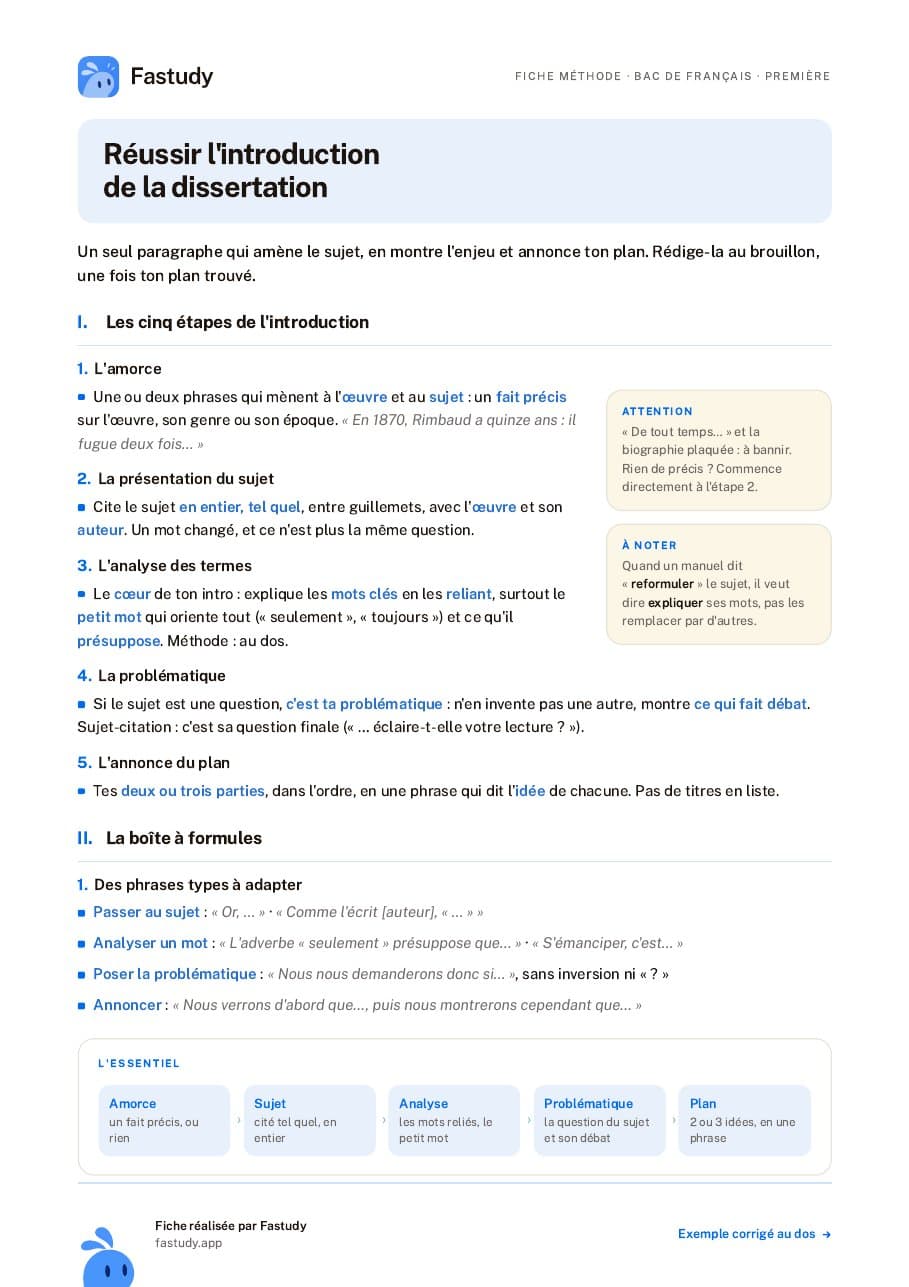
You think the introduction through first, in your draft, because analyzing the prompt guides your whole plan. But you write the final version once your plan is settled, so that it announces exactly what you are going to do.
1. Lead into the prompt
One sentence that leads to the question asked: a fact about the work, how it was received, a debate it sparked. For a prompt on Alcools: “In 1913, Apollinaire removed all the punctuation from his collection just as it was being published.”
As in the commentary, the opening has only one requirement: to lead to this particular prompt. If it could open any essay, it is useless.
2. Quote the prompt and place the work
You copy the prompt word for word, in quotation marks, then you place the work: its author, its date, its genre, and the course theme it is studied with (parcours) if the prompt mentions it. It is the simplest step, and yet the one most often missed: a prompt that has been summarized or rephrased is no longer quite the same prompt.
3. Analyze the words of the prompt
This is the heart of the introduction. Take each important word and ask yourself what it means in this work:
- Key words carry the theme: “passion,” “modernity,” “communicate.”
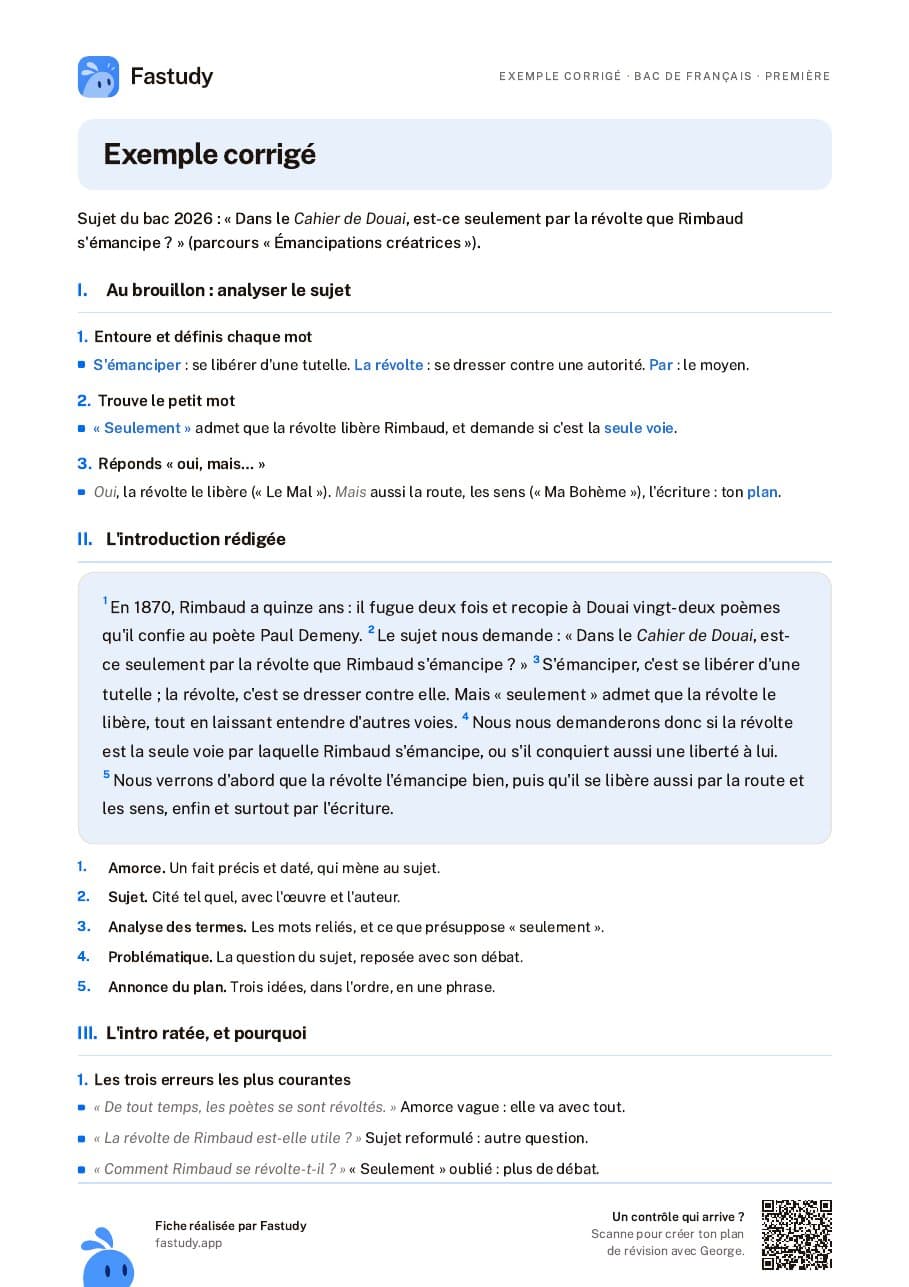
- Function words steer the whole prompt: “only,” “nothing but,” “always,” “is it.” At the 2026 bac, the prompt on Rimbaud asked: « Dans le Cahier de Douai, est-ce seulement par la révolte que Rimbaud s'émancipe ? » (“In the Cahier de Douai, is it only through revolt that Rimbaud frees himself?”). Everything rested on « seulement » (“only”): forgetting it meant missing the point of the prompt.
- Assumptions. What the prompt takes for granted: a prompt that asks whether a work is “only” something accepts that it is that thing at least in part.
4. Set out the central question
When the prompt is a question, it is your central question: you don't invent another one. You ask it again in its own words, showing from your analysis what is open to debate: what the prompt accepts, and what can be set against it or added to it. “We will therefore ask whether…” is enough, with no inversion and no question mark.
When the prompt starts from a quotation, the question is the one that comes with it (« Partagez-vous ce point de vue ? », “Do you share this view?”; « Cette affirmation éclaire-t-elle votre lecture ? », “Does this statement shed light on your reading?”): your central question then takes up the words of the quotation.
5. Announce the plan
Two or three parts, in order, in one smooth sentence. A prompt built on “only” or “nothing but” often calls for a plan that first accepts the claim, then qualifies it or goes beyond it.
Three complete introductions
The same method, on three genres. The prompts are typical prompts, made up for this page.
A novel: La Princesse de Clèves
Published without the author's name in 1678, La Princesse de Clèves got its first readers arguing over one scene: the heroine's confession to her husband that she loves another man. The prompt asks: “Is La Princesse de Clèves only a novel of romantic passion?” Madame de La Fayette's novel does tell the story of the princess's love for the Duc de Nemours; but the adverb “only” invites us to look at what the heroine does with this passion, which she fights, confesses and finally gives up. We will therefore ask whether La Princesse de Clèves is only a novel of romantic passion, or whether this passion also allows it to portray the lucidity of a heroine who chooses renunciation. We will first see that passion dominates the whole novel, then that it becomes the means of a reflection on lucidity and renunciation.
What it does well: the prompt is quoted as it is, “only” is analyzed, the central question keeps the words of the prompt, and the plan follows directly from that analysis.
A play: Juste la fin du monde
In Juste la fin du monde, written in 1990, Jean-Luc Lagarce imagines a homecoming: Louis returns to his family after years away to announce that he will soon die, and leaves without having said it. The prompt reads: “Juste la fin du monde is a play about the impossibility of communicating. Do you share this view?” The word “impossibility” is strong: the characters never stop talking, but they talk around the essential, which remains unsaid. We will therefore ask whether the play really shows an impossibility of communicating, or whether the theater lets us hear in another way what the characters cannot manage to say to each other. We will first look at speech held back within the family, then at the way the monologues addressed to the audience let us hear what is left unsaid.
What it does well: the prompt starts from a quotation, and the analysis stops on its strongest word, “impossibility”; the central question takes up the words of the quotation and sets out the tension that the plan will deal with.
A poetry collection: Alcools
In 1913, Apollinaire removed all the punctuation from his collection just as it was being published. The prompt asks: “Is Alcools only a collection of modernity?” Modernity can be seen in this gesture, as in « Zone », which opens the collection on the city and its machines; but “only” forces us to ask what the collection keeps from earlier poetry: its regular verse, its melancholy about love, its legends. We will therefore ask whether Alcools is only a collection of modernity, or whether its modernity renews an older poetry. We will first see what makes Alcools a modern collection, then what it owes to an older poetry that it transforms.
What it does well: the opening is not decorative, it already gives a first argument about modernity, and the plan follows the tension between modernity and tradition.
The mistakes examiners point out
- Rephrasing the prompt. According to the académie d'Aix-Marseille, it is the main cause of going off topic. Quote, then analyze.
- A central question that ignores the words of the prompt. Examiners of the académie de Nancy-Metz noted central questions that did not reflect on the terms given. Each important word must find its place in your thinking.
- Forgetting the function word. “Only,” “nothing but,” “always”: these small words change the whole prompt.
- Vague references. Examples with no precise link to the prompt do not earn credit, the Aix-Marseille FAQ reminds students. A precise example from the work is better than a generality.
- The one-size-fits-all opening. « De tout temps, les hommes… » (“Since the dawn of time, mankind…”) is not mentioned in any official text, but every method site advises against it, for a good reason: it leads to no prompt in particular.
French essay or commentary: what changes in the introduction
Both introductions have the same skeleton: lead in, present, ask a question, announce the plan. But in the French essay, the question is already in the prompt: you quote it and analyze its words. In the commentary, you present a text you have never seen and you are the one who builds the question. The method is explained in detail in Writing a strong commentary introduction.
Frequently asked questions
How long should a French essay introduction be?
There is no official length. Eduscol only says that it can be fairly short. It must leave room for the analysis of the prompt, which is its core, without starting to argue in place of the body.
Should you rephrase the prompt?
No. Quote it word for word, then analyze its terms. Rephrasing is the main cause of going off topic, because a summarized prompt is no longer quite the same prompt.
Do you have to come up with your own central question?
No. When the prompt is a question, it is your central question: you ask it again in its own words, showing what is open to debate from the analysis of its terms.
Is a three-part plan required?
No. Two or three parts are accepted. What matters is that your thinking moves forward and answers the question asked.
Can you write « je » (“I”) in the introduction?
The choice of voice is free and the first person is not penalized. The usual choice is still « nous » (“we”) or impersonal phrasing (« on peut se demander », “one may ask”; « il s'agit de savoir », “the question is whether”).