

What Is Your Learning Style?
Free. No email required. The way you learn is unique. Discover it and get study methods that truly work for you.
Why Knowing Your Learning Style Matters
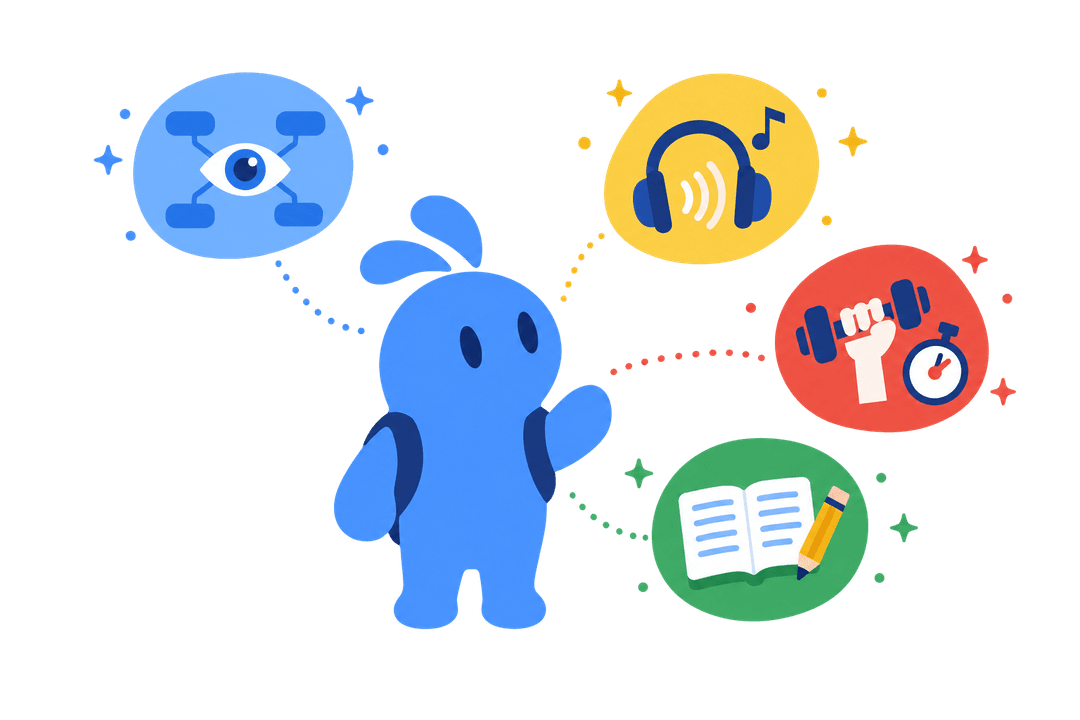
Everyone learns differently. Some retain information best through diagrams and mind maps (visual), others by listening to a podcast or discussing ideas (auditory). Some need to read and rewrite to memorize (read/write), and others only truly understand by doing (kinesthetic).
Knowing your learning preferences means you can stop forcing a method that doesn't work for you. A kinesthetic learner who spends hours rereading notes is wasting time, just like an auditory learner who makes flashcards but never discusses them.
But your sensory profile is only part of the equation. Your personality changes everything: are you more effective alone or in a group? Do you need structure or freedom? Do you prefer real-world examples or abstract concepts? Do you learn better through logic or emotion?
By crossing your 4 sensory modalities with your 4 personality traits, our test generates a truly unique learning profile with personalized study strategies. Not just a label like "you're visual," but a concrete action plan to study more effectively, whether for exams, certifications, or professional development.

A Test Built on Education Research
Our test combines two complementary approaches from educational psychology to go beyond standard quizzes.
Neil Fleming's VARK model (1987) measures your sensory preferences across four modalities: Visual, Auditory, Read/Write, and Kinesthetic. Rather than boxing you into a single category, we calculate your relative profile across all four axes. Research shows that the majority of learners are multimodal: you're not "one type," you have a unique blend of preferences.
Personality dimensions inspired by Carl Jung's psychology complete this profile. Two visual learners don't study the same way if one is social and structured while the other is solitary and spontaneous. We measure four axes: Social/Solitary, Structured/Spontaneous, Concrete/Abstract, and Analytical/Empathetic.
The result: cross-referenced recommendations that account for both how you receive information and how you process it. Everything is calculated in your browser: only your email, if you provide it, is saved with your result.
Are Learning Styles a Myth? What the Research Actually Says
You will find articles claiming that learning styles are a myth. The claim deserves a straight answer rather than silence.
What the research contests is specific: the meshing hypothesis. Since Pashler and colleagues published their review in 2008, controlled studies have repeatedly failed to show that teaching someone in their preferred modality improves how much they actually learn. Show a diagram instead of a text to a visual profile, and recall does not reliably improve. That finding holds, and any test that ignores it is selling you something.
What is not contested is that the preferences themselves are real and stable. People genuinely differ in how they like to work, and that preference often decides whether they open the material at all. This is not a detail: the method you will actually stick with beats the theoretically optimal method you abandon after three days.
So read your result for what it is: a description of how you prefer to work, not a ceiling on what you can learn. Use it to pick a format you will come back to, then vary the formats anyway. Learning almost anything well means combining several: seeing it, saying it, reading it, doing it.
Frequently Asked Questions
The 4 Learning Styles

Visual
You learn best through images, diagrams, charts, and spatial understanding. You think in pictures and benefit from visual representations of information.

Auditory
You learn best through listening, discussing, and verbal explanations. You retain information well when it's presented through sound and conversation.

Read/Write
You learn best through reading and writing. You prefer text-based information and benefit from taking detailed notes, creating lists, and reading extensively.

Kinesthetic
You learn best through hands-on experience, practice, and physical interaction. You prefer doing rather than just reading or listening.
Instant results. No email required.
Start the Free Quiz