
For the literary commentary (commentaire de texte), you have a text you have never seen, four hours ahead of you, and a blank page. The introduction is the first paragraph your examiner will read, and it is also the one that forces you to know where you are going. This page explains what is really expected of you, how to build each step, and shows the method applied to a novel, a play and a poem.
What the examiner really expects
There is no official method for the introduction, and the official texts say so clearly: no one can demand a “standard” introduction from you, and your mark is not split into points for the introduction, the body and the conclusion. What they do expect, however, is precise:
- A coherent reading of the text. According to Eduscol's assessment guide, this reading plan (projet de lecture) is the heart of the exercise: your commentary must be organized around one reading of the text, not a string of remarks. The introduction is where you announce it.
- A presentation that starts from the paratext. The académie d'Aix-Marseille sums it up like this for students: briefly present the author, the title and the subject of the text, drawing on what the exam paper gives you.
- Describing the text rather than its context. The French inspectors of the académie de Bordeaux would rather you say what kind of text it is and what it does than file it under a literary movement.
- No biography, no required literary movement. Nothing about the author's life or the history of the century is expected. Literary context earns credit when it serves your reading, but wrongly linking the text to a movement is penalized.
In other words: your introduction does not have to be scholarly. It must show that you have understood what the text does and that your commentary is going somewhere.
The method, step by step
The introduction fits in a single paragraph. You write it in your draft after finding your plan: it is the plan that gives you your central question (problématique), not the other way around.
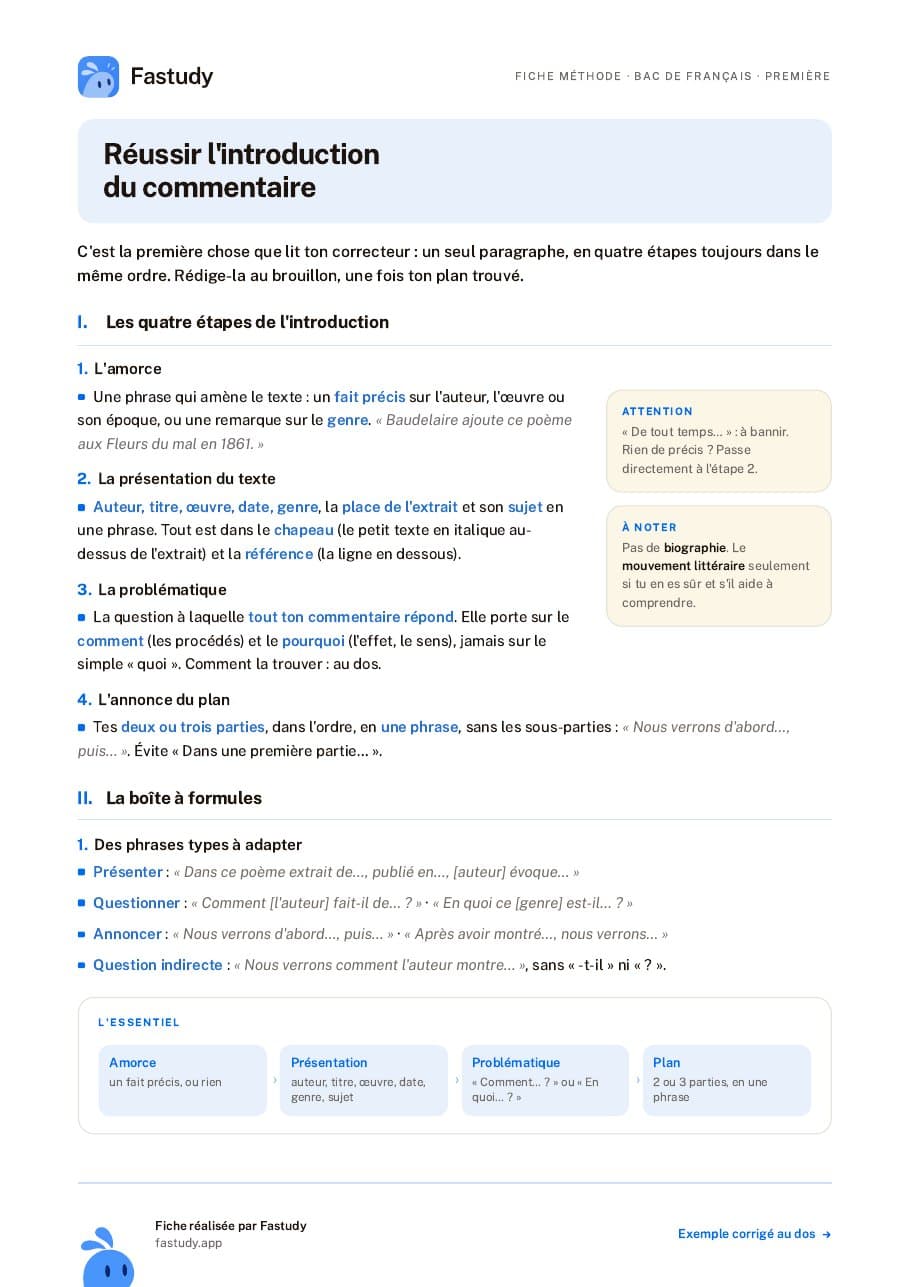
1. Lead into the text, or not
The opening is a sentence that leads to the text: a precise fact about the work, its publication, its genre. On the opening of Bel-Ami, for example: “In 1885, Maupassant published the story of a penniless young man determined to succeed in Paris.”
It has only one condition: to be precise. A sentence that would fit any text gives you nothing. And it is optional: if you know nothing precise about the context, start directly with the presentation. No one will hold it against you.
2. Present the text and say what it does
Everything you need is in the paratext: the short introduction in italics above the extract and the reference below it. From them you take the author, the title, the date, the genre and where the extract sits in the work.
Then, in one sentence, you say what the text does. Not a line-by-line summary: what it tells or describes, and what is special about it. For « Demain, dès l'aube »: “Hugo describes a walk across the Normandy countryside that seems to lead to a meeting, until the last stanza reveals a grave.” This sentence already prepares your central question.
3. Ask your central question
This is the question your whole commentary answers. It comes from what struck you as you read, not from a ready-made formula. Four ways to find it:
- What surprises you. A contrast, a break, an ending that changes the meaning of everything before it.
- How the text moves. Where it starts, where it ends up: “How does this text take us from… to…?”
- The genre and what the text does with it. An opening scene that is also a comic scene, a portrait that is also a criticism.
- Its effect on you. Pity, laughter, unease: which techniques create this effect?
Frame it around how and why, with « Comment… ? » or « En quoi… ? » (“How…?”, “In what way…?”). If you prefer an indirect question, build it without inversion and without a question mark: « Nous verrons comment Molière fait rire d'un malade qui se croit mourant. » (“We will see how Molière makes us laugh at a sick man who thinks he is dying.”)
4. Announce your plan
Two or three parts, in order, in one sentence, without the subparts. A two-part plan is perfectly acceptable: what matters is that your reading moves forward. Phrase ideas rather than headings, and avoid the mechanical “In a first part… In a second part…”.
In the technological track (voie technologique), the exam paper suggests lines of reading (axes de lecture). Using them as your two parts is the safest option, even though another well-justified reading is accepted.
Three complete introductions
The same method, on three genres. Each time: the opening, the presentation and what the text does, the central question, the announcement of the plan.
A novel: the opening of Bel-Ami
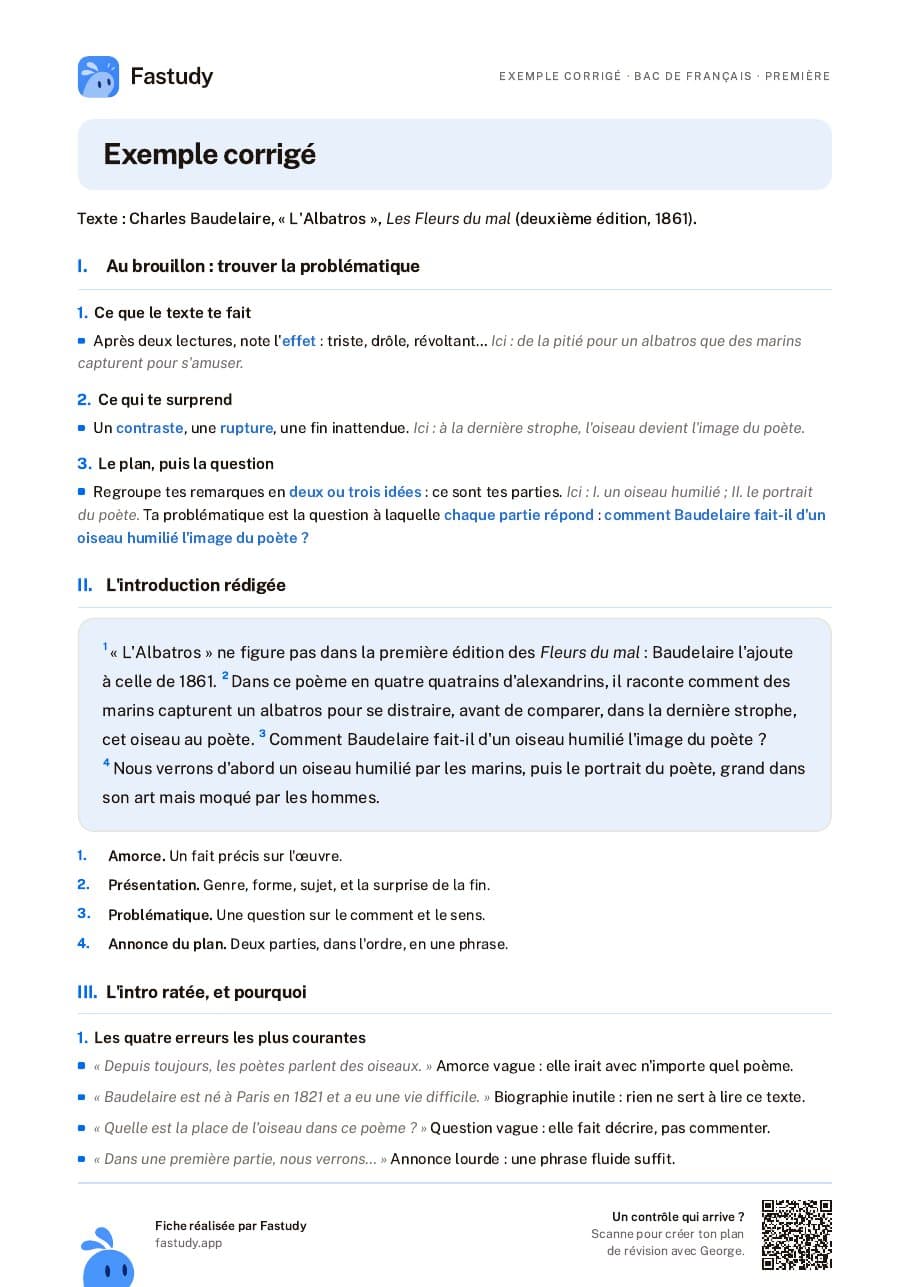
In 1885, Maupassant published the story of a penniless young man determined to succeed in Paris. From the first page of Bel-Ami, Georges Duroy, a former non-commissioned officer, walks out of a restaurant with three francs forty in his pocket to last until the end of the month, and strolls along the boulevard staring at the passers-by. How does this opening turn a poor, idle man into a conqueror in the making? We will first see the portrait of a modest, almost wretched character, then the self-assurance of a seducer who already looks at Paris as his prey.
What it does well: the presentation spots the gap between Duroy's poverty and his self-assurance, and this gap gives both the central question and the two parts.
A play: the first scene of Le Malade imaginaire
Le Malade imaginaire is Molière's last play: he died in 1673, a few hours after the fourth performance, in which he himself played Argan. The play opens with a monologue: alone on stage, Argan checks his apothecary's bills and counts his remedies one by one. In what way does this opening scene already make Argan a comic character? We will see that it presents a sick man obsessed with his health, then that it makes him ridiculous through repetition and play with numbers.
What it does well: it links the genre (an opening scene, scène d'exposition) to the effect (laughter), and the central question is about how, not about what happens in the scene.
A poem: « Demain, dès l'aube » by Victor Hugo
In 1843, Léopoldine, Victor Hugo's eldest daughter, drowned in the Seine at Villequier. In Les Contemplations, published in 1856, the poem « Demain, dès l'aube » describes in three quatrains a walk across the Normandy countryside that seems to lead to a meeting, until the last stanza reveals a grave. How does Hugo turn the account of a journey into a tribute to his lost daughter? We will first see how the poem keeps up the expectation of a meeting, then how it becomes a poem of mourning.
What it does well: here, the biographical information is useful, because it directly sheds light on the meaning of the poem. This is exactly the case where context belongs.
The mistakes examiners point out
The marking reports published by the académies and Eduscol's assessment guide point to the same weaknesses. A report from the académie de Grenoble even notes that the form of the introduction is respected in almost every paper: what costs marks is the content.
- No common thread. The paper jumps from remark to remark with no overall reading. A clear central question in the introduction is the best way to avoid this.
- Paraphrase. Retelling the text instead of analyzing it, from the introduction onward. One sentence saying what the text does is enough.
- A badly built indirect question. « Nous verrons comment l'auteur montre-t-il… ? » mixes the two forms. Choose one: the direct question « Comment l'auteur montre-t-il… ? » or the indirect one « Nous verrons comment l'auteur montre… ».
- The wrong literary movement. Linking a text to a movement it does not belong to is penalized. When in doubt, talk about the genre.
Commentary or French essay: what changes in the introduction
Both introductions have the same skeleton: lead in, present, ask a question, announce the plan. But what you present changes. In the commentary, you present a text and you are the one who builds the question. In the French essay (dissertation), the question is already in the prompt: you quote it and analyze its words. The method is explained in detail in Writing a strong French essay introduction.
Frequently asked questions
How long should a commentary introduction be?
There is no official length. A single paragraph of a few lines is enough: enough to present the text, ask your central question and announce your plan, without starting to analyze.
Should you mention the literary movement?
Only if you are sure of it and it helps understand the text. Examiners reward literary context that serves the interpretation, but a wrong link to a movement is penalized. If in doubt, present the genre of the text instead.
Is the central question compulsory?
What is expected is a coherent reading of the text. The central question is the clearest and safest way to announce it, which is why almost every method puts it in the introduction.
Can you write « je » (“I”) in the introduction?
The choice of voice is free and the first person is not penalized. The usual choice is still « nous » (« Nous verrons… », “We will see…”) or impersonal phrasing, which gives a more neutral tone.
Should you announce the movements of the text?
No, in the written exam you announce the parts of your commentary. The movements of the text are the rule of the linear explanation (explication linéaire) in the oral exam. One exception: if you write a linear commentary, which follows the text, you announce its movements and what they show.