
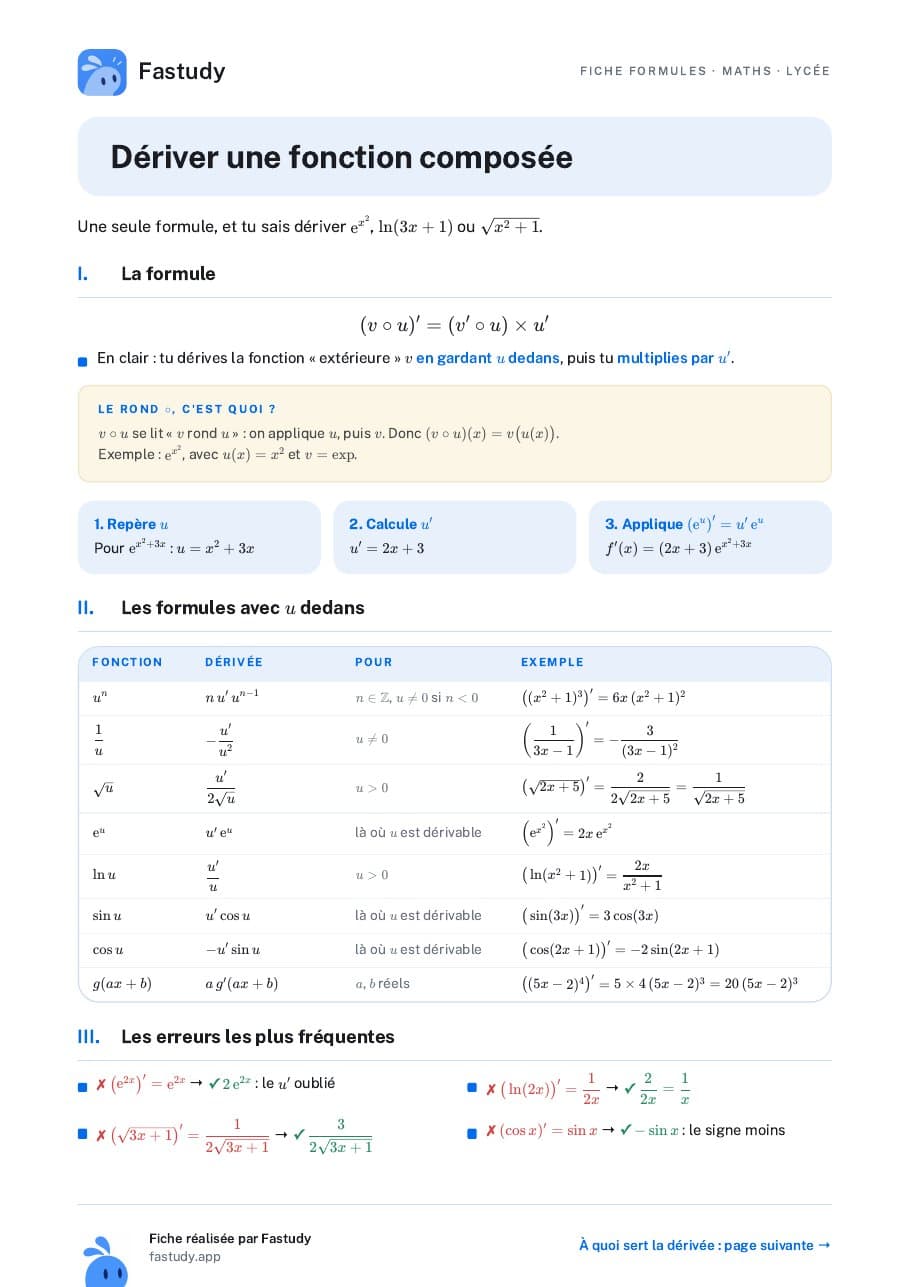
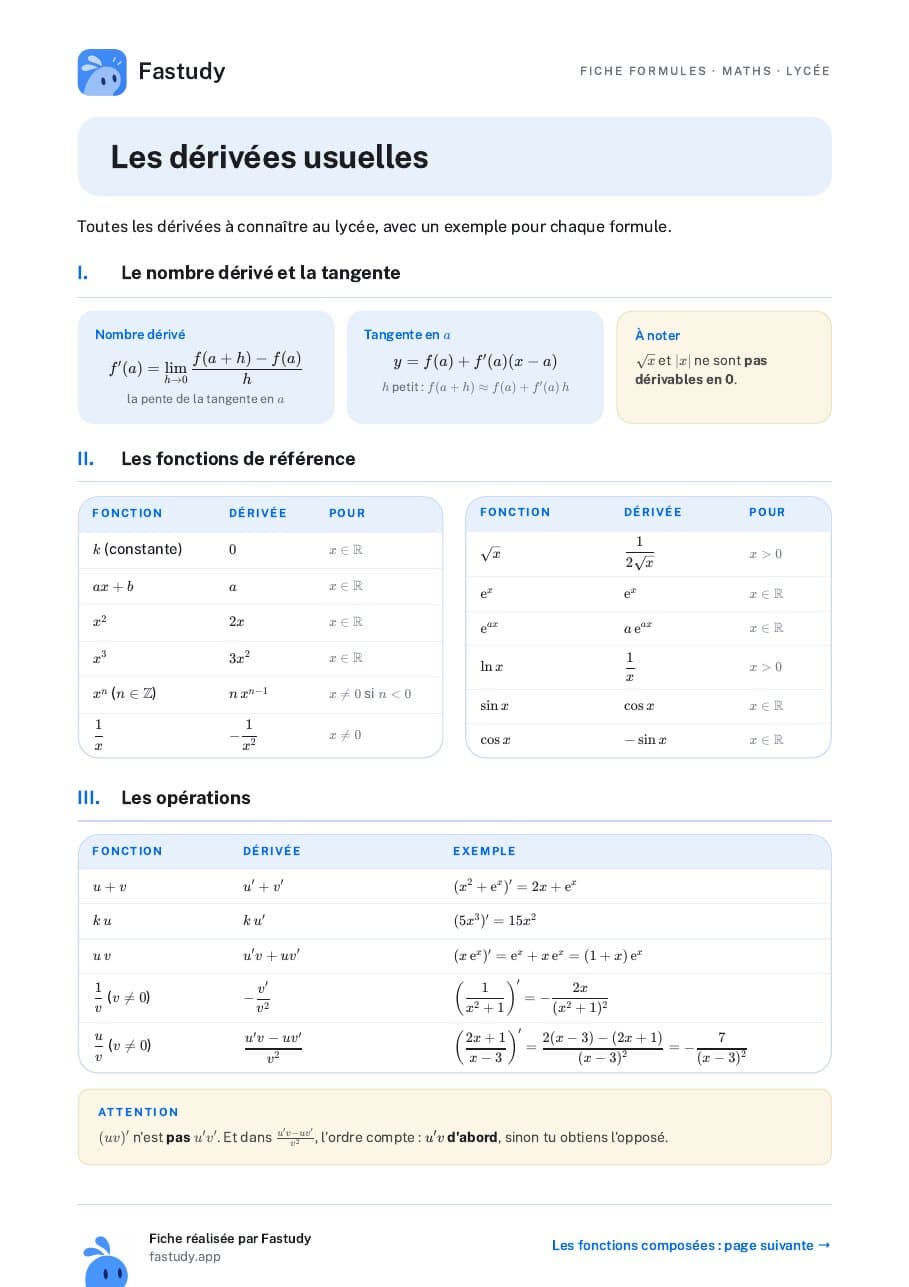
Knowing the formulas is not enough: in a test, the hard part is knowing which one to apply, then carrying the calculation through to a useful form. The PDF sheet gathers every derivative from high school. This page explains how to use them: recognize the form of a function, set up the calculation without getting lost, and use the derivative to study variations. Three full derivatives show the method in action.
On this page, f′ is read “f prime” and e^(u) means “exponential of u”.
What your teacher expects on paper
A correct derivative does not earn full marks if nobody can follow your working. What makes a paper easy to read:
- Say which interval you differentiate on. A function that contains ln u, √u or a quotient is not differentiable everywhere: state the interval (where u > 0, or where the denominator is not zero).
- Name the pieces. Write u(x) = …, then u′(x) = …, and the same for v. Your teacher sees right away which formula you are using, and you avoid mixing up terms.
- Write the formula before substituting. “f′ = u′v + uv′” on one line, then the calculation. One extra step, far fewer mistakes.
- Go all the way to a usable form. If the next question asks for the variations, a derivative left in a mess is useless: factorize it so you can read its sign.
The method, step by step
1. Recognize the form of the function
Before any calculation, look at the last operation you would do to compute f(x) for a given value of x. That is what decides the formula.
- f(x) = (3x − 1) ln x: you compute 3x − 1, then ln x, then you multiply. It is a product u × v.
- g(x) = eˣ / (x + 2): you finish by dividing. It is a quotient u / v.
- h(x) = √(4 − x²): you compute 4 − x², then take the square root of the result. It is a composite function, of the form √u.
If you hesitate, ask yourself what is “inside” what. Whatever is under a root, inside a ln, in the exponent of an exponential or in brackets raised to a power is u.
2. Name u and v, and differentiate them separately
Write each piece on its own line, with its derivative. For f(x) = (3x − 1) ln x on (0, +∞):
- u(x) = 3x − 1, so u′(x) = 3;
- v(x) = ln x, so v′(x) = 1/x.
Once these small calculations are done, all that is left is to fill in the formula. This is also where you spot a composite hidden inside a product: in x e^(−x), v(x) = e^(−x) is differentiated as −e^(−x).
3. Apply the formula, then simplify
Substitute into the formula, skipping nothing: f′(x) = 3 ln x + (3x − 1) × 1/x = 3 ln x + 3 − 1/x.
Simplifying does not mean expanding everything. Keep the common factors: with an exponential, factor it out; with a quotient, keep the squared denominator as it is, since it is always positive.
4. Read the sign of the derivative
The derivative is almost always used to study variations: f′ positive, f increasing; f′ negative, f decreasing. To read its sign you need a factorized form, where each factor has a sign that is easy to find:
- an exponential is always strictly positive;
- a square, like (x − 1)², is positive or zero;
- a first-degree factor, like 2x − 4, changes sign at exactly one value.
The sign of a sum, on the other hand, cannot be read. That is why you factorize.
Three derivatives worked out step by step
A product: f(x) = (x² − 2x) eˣ on ℝ
Form. You compute x² − 2x and eˣ, then multiply: it is a product u × v.
Pieces. u(x) = x² − 2x, so u′(x) = 2x − 2. v(x) = eˣ, so v′(x) = eˣ.
Calculation. f′(x) = u′v + uv′ = (2x − 2) eˣ + (x² − 2x) eˣ. Factor out eˣ: f′(x) = (2x − 2 + x² − 2x) eˣ = (x² − 2) eˣ.
Sign. eˣ > 0, so f′(x) has the sign of x² − 2, which is zero at −√2 and at √2. f is increasing on (−∞, −√2], decreasing on [−√2, √2], increasing on [√2, +∞).
Key takeaway. With an exponential in a product, factor it out first: only a polynomial is left to study.
A quotient: g(x) = (x² + 3) / (x − 1) on (1, +∞)
Form. You finish by dividing: it is a quotient u / v, and v is never zero on (1, +∞).
Pieces. u(x) = x² + 3, so u′(x) = 2x. v(x) = x − 1, so v′(x) = 1.
Calculation. g′(x) = (u′v − uv′) / v² = [2x(x − 1) − (x² + 3)] / (x − 1)² = (x² − 2x − 3) / (x − 1)².
The numerator factorizes: x² − 2x − 3 = (x − 3)(x + 1). So g′(x) = (x − 3)(x + 1) / (x − 1)².
Sign. On (1, +∞), (x − 1)² > 0 and x + 1 > 0: g′(x) has the sign of x − 3. g is decreasing on (1, 3] and increasing on [3, +∞). Its minimum is g(3) = 12 / 2 = 6.
Key takeaway. Never expand the denominator: (x − 1)² is positive, so keep it as it is and work only on the numerator.
A composite function: h(x) = ln(x² − 4x + 5) on ℝ
Form. You compute x² − 4x + 5, then take its logarithm: it is ln u. You need u > 0: here, x² − 4x + 5 = (x − 2)² + 1, which is always greater than or equal to 1. So h is defined and differentiable on ℝ.
Pieces. u(x) = x² − 4x + 5, so u′(x) = 2x − 4.
Calculation. h′(x) = u′ / u = (2x − 4) / (x² − 4x + 5).
Sign. The denominator is strictly positive, so h′(x) has the sign of 2x − 4: negative before 2, positive after. h is decreasing on (−∞, 2] and increasing on [2, +∞). Its minimum is h(2) = ln 1 = 0.
Key takeaway. The derivative of ln u is not 1/u but u′/u: it is u′ that carries all the information about the variations.
The most common mistakes
- Differentiating a product factor by factor. (uv)′ is not u′v′. With x eˣ, that would give eˣ instead of (1 + x) eˣ.
- Swapping the terms of the quotient numerator. It is u′v − uv′, in that order. The other way round, you get the opposite of the derivative, and every variation is wrong.
- Forgetting the u′ of a composite. (e^(3x))′ = 3 e^(3x), not e^(3x). Same for ln u, √u and uⁿ: every formula “with u inside” ends with a factor u′.
- Writing (ln u)′ = 1/u. The right formula is u′/u. You only get 1/x for ln x, because u′ is 1.
- Expanding for nothing. An expanded denominator or an exponential spread over every term makes the sign impossible to read. Factorize instead of expanding.
- Forgetting the domain of differentiation. √x is not differentiable at 0, ln u only exists if u > 0, and a quotient makes no sense where v is zero. Saying so avoids wrong conclusions.
Frequently asked questions
What is the difference between f′(a) and f′(x)?
f′(a) is a number: the slope of the tangent to the curve at the point with x-coordinate a. f′(x) is a function, which gives that slope for every value of x. You compute f′(x) once, then replace x with a to get f′(a).
How do you find the equation of a tangent?
The tangent at the point with x-coordinate a has equation y = f′(a)(x − a) + f(a). Compute f(a) and f′(a), substitute, then expand to get the form y = mx + p.
How do you remember the quotient formula?
It looks like the product formula with a minus sign in the numerator and v² underneath: (u′v − uv′) / v². To avoid swapping the order, remember that the numerator starts like the product one, with u′v.
What do you do when a function is both a product and a composite function?
You apply the formulas one inside the other. For f(x) = x e^(−x): it is a product, with u(x) = x and v(x) = e^(−x). The derivative of v is that of a composite function, v′(x) = −e^(−x). So f′(x) = e^(−x) − x e^(−x) = (1 − x) e^(−x).
Why do you have to factorize the derivative?
Because you are looking for its sign, and the sign of a product is read factor by factor. A sum like x² eˣ − 2 eˣ tells you nothing; written (x² − 2) eˣ, it has the sign of x² − 2, since eˣ is always positive.